





Helping injured clients understand their rights after a truck accident in Wisconsin.
If you have been injured in a truck accident in Wisconsin, the legal process that follows is often far more complicated than a standard auto collision claim. Commercial trucking cases involve federal safety regulations, multiple potentially liable parties, and insurance carriers with substantial resources. The decisions you make in the weeks after the accident can shape the entire outcome.
Johnston | Martineau PLLP represents individuals and families throughout Wisconsin who have been harmed in collisions with commercial trucks. Our Wisconsin truck accident lawyer has devoted years to these cases and understands both the federal regulations and Wisconsin laws that apply. We offer free consultations and accept every case on a contingency basis, meaning you pay nothing unless we recover for you.
Truck Accident Lawyer Wisconsin
A truck accident lawyer investigates the crash, identifies the responsible parties, and pursues compensation through negotiation or litigation. In Wisconsin, these cases are governed by a combination of state negligence law and federal trucking regulations enforced by the Federal Motor Carrier Safety Administration (FMCSA). Those regulations set requirements for driver qualifications, vehicle maintenance, hours of service, and cargo securement.
A Wisconsin truck accident attorney also knows that critical evidence has a short shelf life. Electronic logging device data, onboard event recorder information, and dispatch records can be overwritten within weeks. Sending a preservation demand to the trucking company immediately after the crash is one of the most important steps an attorney takes.
Types of Truck Accident Cases We Handle in Wisconsin
Wisconsin's position as a corridor for interstate commerce means its highways carry substantial truck traffic. Interstates 90, 94, and 43 see heavy commercial vehicle volumes year-round. Johnston | Martineau PLLP handles truck accident cases across the state, including:
- Semi-truck accidents. Semi-truck collisions on Wisconsin interstates produce some of the most serious injuries our firm encounters. We examine driver conduct, carrier compliance records, and the vehicle's mechanical condition to establish negligence.
- Fuel truck accidents. Collisions involving fuel tankers carry added dangers of fire, explosion, and hazardous chemical release. These cases require investigation into the carrier's compliance with federal hazmat transport regulations.
- Tanker truck accidents. Tanker trucks hauling liquids are prone to rollover because of shifting cargo weight. When a rollover occurs due to speeding, improper loading, or inadequate driver training, the carrier and driver may both bear liability.
- Logging truck accidents. Wisconsin's timber industry puts logging trucks on rural highways across the northern and central regions. Overloaded trailers, unsecured cargo, and poorly maintained equipment contribute to these crashes.
- Concrete truck accidents. Concrete mixer trucks are heavy, slow to stop, and difficult to maneuver. Collisions with these vehicles often occur near construction sites or on congested roads and can produce severe injuries.
- Steel truck accidents. Improperly secured steel loads can shift during transport, causing the truck to lose control or the cargo to strike other vehicles. These cases may involve claims against both the carrier and the loader.
- Fatal truck accidents. When a truck accident results in death, Wisconsin law permits surviving family members to pursue a wrongful death claim. These actions must be filed within three years and may include compensation for burial expenses, lost financial support, and loss of companionship.
- Reckless driving and fatigue-related crashes. Speeding, aggressive lane changes, and drowsy driving by commercial truck operators cause preventable collisions throughout Wisconsin. Violations of federal hours of service rules are frequently a factor in fatigue-related crashes.
Why Choose Johnston | Martineau PLLP for Truck Accident Cases in Wisconsin?
Attorneys Licensed and Active in Wisconsin
Christopher P. Martineau is licensed to practice in Wisconsin and handles truck accident claims, wrongful death litigation, and major motor vehicle collision cases throughout the state. Mr. Martineau earned his law degree from Hamline University School of Law and his undergraduate degree from the University of Wisconsin-Oshkosh. He is admitted in Wisconsin, Minnesota, and the U.S. District Court for the District of Minnesota. Mr. Martineau is a member of the Academy of Truck Accident Attorneys (ATAA), the Minnesota Association for Justice, and the Minnesota State Bar Association.
Christopher A. Johnston represents truck accident victims across multiple jurisdictions. Mr. Johnston has concentrated his career on claims involving semi-trucks, tanker trucks, and commercial vehicles. He earned his law degree from William Mitchell College of Law and his undergraduate degree from the University of Minnesota. Mr. Johnston is licensed in Minnesota and Iowa and is admitted to the Eighth Circuit Court of Appeals and the U.S. District Court for the District of Minnesota. He has been named a Super Lawyer five times and was recognized as a Rising Star in 2011. Mr. Johnston is a member of the Million Dollar Advocates Forum after achieving a million-dollar settlement, a distinction held by fewer than one percent of attorneys nationwide. He also belongs to the American Association for Justice and the Minnesota Association for Justice.
Proven Results for Truck Accident Clients
Johnston | Martineau PLLP has obtained millions of dollars in recoveries for truck accident and personal injury clients. Every case is handled on a contingency basis, meaning you owe nothing unless we recover on your behalf. Our experienced Wisconsin truck accident lawyers bring the same preparation to every case whether it resolves through settlement or trial.
What Is Important to Understand About a Truck Accident Case?
Damages, Liability, and Compensation for Truck Accident Cases
A person injured in a truck accident in Wisconsin may be eligible to recover damages across several categories. The compensation available depends on the severity of injuries, the conduct of the parties, and the financial consequences of the crash.
Economic damages are documented financial losses: medical bills, surgical costs, ongoing therapy, prescription medications, lost wages, and any long-term reduction in earning ability.
Non-economic damages account for the personal impact of injuries. Physical pain, emotional suffering, loss of enjoyment of life, and harm to family relationships all fall within this category. Wisconsin law recognizes these losses as compensable.
If a truck accident causes death, Wisconsin permits the decedent's family to file a wrongful death claim. Recoverable losses include funeral expenses, lost future income, and loss of society and companionship. The deadline is three years.
- Hospital, surgical, and rehabilitation costs
- Lost income and reduced future earning capacity
- Physical pain and lasting discomfort
- Emotional and psychological harm
- Loss of society and companionship for family members
- Burial and funeral expenses in wrongful death cases
What Are Important Aspects of a Truck Accident Case?
Truck accident litigation involves procedural and evidentiary considerations not present in ordinary collision claims. Understanding these aspects early helps shape the strategy for pursuing compensation.
- Federal regulations administered by the FMCSA set standards for driver fitness, maximum driving hours, mandatory rest, vehicle inspection, and cargo securement that apply to all interstate carriers
- Liability may extend to the driver, the trucking company, vehicle maintenance contractors, cargo shippers, and in some cases the manufacturer of a defective component
- Carriers must retain electronic logging device (ELD) records, dispatch logs, driver qualification files, and post-trip inspection reports
- Evidence preservation is urgent because trucking companies routinely overwrite electronic data and may repair or dispose of the vehicle shortly after a collision
What Is the Truck Accident Case Timeline?
The length of a truck accident case varies depending on liability complexity, injury severity, and the insurer's response to the claim. Most cases follow this general sequence.
- Medical care and recovery. Thorough medical treatment is essential both for the injured person's health and for documenting the damages. Medical records serve as the foundation of the claim.
- Investigation. The attorney issues preservation notices to the trucking company and begins collecting police reports, black box data, witness statements, and any available video or photographs.
- Demand preparation. After maximum medical improvement is reached or the scope of damages becomes clear, the attorney assembles a demand package and submits it to the responsible insurer.
- Negotiation and mediation. The insurer reviews the demand and responds. Negotiations may proceed through multiple rounds, and mediation can be used when direct negotiation stalls.
- Litigation. If the case cannot be resolved through negotiation, a lawsuit is filed. Discovery, depositions, and trial preparation follow, and the process can extend a year or longer.
What Should You Bring to Your Truck Accident Consultation?
Having relevant records available when you meet with a truck accident attorney allows for a more productive evaluation. If certain documents are not yet in your possession, you can still schedule a consultation.
- The police accident report, or alternatively the case number assigned by the investigating agency that responded to and investigated the collision.
- Any photographs or video footage captured at the scene of the accident, including images that document the condition of the vehicles involved and the nature and extent of your injuries.
- Hospital records, specialist consultation notes, diagnostic imaging results, and all medical bills associated with the treatment you received as a result of the crash.
- Pay stubs, tax returns, or written statements from your employer that document any wages or income lost during your recovery period.
- All correspondence received from insurance companies or from any representatives acting on behalf of the trucking company or its insurer.
We will review the details of your case, explain how Wisconsin and federal law apply, and provide an honest evaluation. The consultation is free, and there is no obligation.
What Are Important Wisconsin Legal Resources for Truck Accident Cases?
Wisconsin statutes and federal trucking regulations both govern truck accident claims in the state. The following resources provide access to the primary laws that apply.
- Wis. Stat. § 893.54 sets the statute of limitations for personal injury claims in Wisconsin at three years from the date of injury.
- Wisconsin follows a modified comparative negligence rule under Wis. Stat. § 895.045. An injured person whose fault reaches 51 percent or more is barred from recovering damages. Below that threshold, damages are reduced in proportion to the claimant's share of fault.
- The FMCSA regulates interstate commercial carriers and enforces federal safety standards, including hours of service limits, vehicle maintenance requirements, and driver qualification rules.
- NHTSA large truck data provides national statistics on fatalities and injuries in crashes involving large commercial trucks.
- The Wisconsin Department of Transportation publishes state-level crash data and highway safety resources.
Reach Out to Johnston | Martineau PLLP to Schedule a Consultation
If a truck accident in Wisconsin has left you or a family member with serious injuries, our experienced Wisconsin truck accident lawyer can help you understand your options. Johnston | Martineau PLLP offers free consultations and represents clients on a contingency basis. Contact us to schedule your free case evaluation.
Big Rig Accident Statistics in Wisconsin
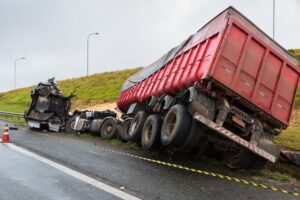 A loaded tractor-trailer can weigh 80,000 pounds. When one strikes a passenger car at highway speed, the smaller vehicle absorbs most of the force, and the cases that our Wisconsin big rig accident lawyers handle reflect that.
The state's own numbers show how common these collisions are, and they shape how a truck accident lawyer in Wisconsin evaluates a new case. Interstate corridors carry the heaviest truck volumes. Sideswipes and rear-end collisions are the two crash types that show up most often when a semi is involved. January produced more commercial vehicle crashes than any other month in 2024, which matches our own caseload once ice and snow arrive.
- According to the 2024 Wisconsin Crash Facts report from WisDOT, commercial motor vehicles were involved in 6,825 crashes statewide in 2024. Those crashes killed 66 people and injured 1,480.
- The same report counts 1,811 commercial truck crashes on Wisconsin interstates in 2024 and another 2,001 on state highways.
- Truck tractors pulling a trailer were part of 4,476 Wisconsin crashes in 2024, including 44 fatal crashes, per WisDOT.
- Nationally, NHTSA large truck data for 2024 reports 5,340 deaths and an estimated 161,201 injuries in crashes involving large trucks.
- NHTSA also reports that 69 percent of the large trucks in fatal crashes during 2024 were heavy trucks rated above 26,000 pounds, the category that includes semis and 18-wheelers.
Mistakes That Can Damage Your Wisconsin Truck Accident Claim
Trucking companies and their insurers start working on a crash the same day it happens. The people hurt in the crash usually don't. That gap creates room for errors a big rig accident attorney in Wisconsin sees repeated in case after case.
- Giving a recorded statement to the carrier's insurer. An adjuster may call within days asking for your account "for the file." Anything you say can later be used to argue your own driving contributed to the collision. You aren't required to give that statement.
- Waiting to see a doctor. Adrenaline masks pain. Disc injuries and mild traumatic brain injuries often don't produce clear symptoms for several days. A gap before the first medical visit gives the insurer an opening to claim the injury came from somewhere else.
- Posting about the crash online. A photo from a weekend outing, a restaurant check-in, or a comment that you are "doing better" can all end up in the claim file. Insurers review social media. Photos and check-ins have weakened claims that were otherwise strong.
- Accepting the first settlement offer. Early offers arrive before the full cost of treatment is known. Trucking insurers often lowball crash claims because an injured person with unpaid bills may accept whatever is offered.
- Letting the truck's own evidence disappear. Onboard data, driver logs, and inspection records are not kept forever. Without a written demand to preserve them, the carrier is free to follow its normal retention schedule.
- Assuming the driver is the only responsible party. The motor carrier, the company that loaded the trailer, and a maintenance contractor can each share fault. Some fleets are self-insured trucking operations, which changes how the claim is handled.
- Signing a medical authorization without limits. A broad release lets the insurer pull your entire medical history rather than the records tied to this crash. Back pain from ten years ago then becomes their explanation for the current injury.
- Missing the filing deadline. Wisconsin sets a fixed window for filing a personal injury lawsuit. Negotiating with the insurer does not extend it, and once the window closes the strength of the case no longer matters.
Wisconsin Truck Accident Lawyer FAQs
How much does a Wisconsin truck accident lawyer cost?
The initial consultation is free. We take truck accident claims on a contingency basis and explain how that arrangement works at the first meeting, so you know what to expect before deciding to hire us. There is no charge for asking whether you have a case.
How long do I have to file a truck accident lawsuit in Wisconsin?
Under Wis. Stat. § 893.54, most personal injury claims in Wisconsin must be filed within three years of the date of injury. Some situations shorten that period, so we confirm the deadline that applies to your facts early.
Who can be held responsible after a semi-truck crash in WI?
Responsibility can extend well past the person behind the wheel. Whether the driver or trucking company ends up paying depends on employment status, equipment ownership, and who controlled the load. Shippers and maintenance vendors are sometimes added.
What if the trucking company is based in another state?
Many rigs on Wisconsin highways belong to carriers headquartered elsewhere. That doesn't prevent a claim here. Wisconsin courts can hear cases arising from crashes inside the state, though claims against out-of-state trucking companies involve extra procedural steps.
Can I still recover if I was partly at fault?
Yes, as long as your share of fault is less than 51 percent. Under Wis. Stat. § 895.045, your recovery is reduced in proportion to your share of the blame. A truck accident attorney in Wisconsin will contest inflated fault allegations because every percentage point changes the final number.
Who pays my medical bills while the claim is pending?
Usually your own health insurance or medical payments coverage pays first, and reimbursement is sorted out at settlement. Paying medical bills after a serious truck crash is one of the first questions we address, because balances can go to collections long before the carrier's insurer pays.
Why are truck accident settlements larger than car accident settlements?
The injuries are more severe and the insurance policies are far larger. Commercial carriers must carry liability coverage well above what a private driver carries. That is a large part of why truck wrecks settle higher, though the amount still depends on documented losses.
Does the truck have to be an 18-wheeler for these rules to apply?
No. Straight trucks, dump trucks, and delivery box trucks above certain weight thresholds are treated as commercial motor vehicles. Our commercial truck accident lawyer applies the same investigative approach to a box truck collision as to a tractor-trailer crash.
Do you handle property damage claims as well as injury claims?
We do. Vehicle damage, towing, storage fees, and loss of use are all part of the claim we present. In many big rig cases the vehicle is a total loss, and resolving that portion quickly matters.
Where in Wisconsin do you take truck accident cases?
Statewide. Our Wisconsin truck accident attorneys handle cases from the Milwaukee freeways, the I-94 corridor to the Twin Cities, and the rural highways of the north woods. Much of the work happens by phone and video, so distance from an office rarely matters.
Important Resources for Wisconsin Truck Accident Cases
Most Dangerous Locations for Truck Accidents in Wisconsin
Big rig crash risk concentrates where freight volume, interchanges, and weather meet. The corridors below appear repeatedly in the cases a WI truck accident attorney reviews, from a Wisconsin milk tanker crash on a rural route to interstate pileups.
Dangerous highways for truck accidents in Wisconsin:
- Interstate 94 (Kenosha to Milwaukee to Madison). The state's main freight link to Chicago and the Twin Cities, with constant merging at the Marquette and Zoo interchanges.
- Interstate 39/90 (Rock County to Madison and the Dells). High-speed rural stretches where semis, tourist traffic, and winter weather mix, with a history of multi-vehicle pileups.
- Interstate 43 (Milwaukee to Green Bay). A lakeshore freight route where snow and fog near Sheboygan and Manitowoc cut visibility quickly.
Dangerous streets and local corridors:
- Beltline Highway (US 12/18), Madison. Short merges and heavy commuter traffic crowd trucks headed for the interstate.
- South 27th Street (WIS 241), Milwaukee and Oak Creek. An industrial corridor with truck terminals, tight driveways, and mixed traffic.
- Rose Street (US 53), La Crosse. The primary truck route through the city, lined with business entrances and frequent stops.
What Are Important Local Resources for Wisconsin Truck Accident Cases?
The organizations below can help with crash reports, emergency care, and enforcement questions after a semi-truck accident in Wisconsin.
- Wisconsin State Patrol Headquarters, 1-844-847-1234. Regional posts investigate most interstate truck crashes.
- Wisconsin DOT Crash Reports, technical support (608) 250-4606. Official crash reports can be purchased online once law enforcement completes them.
- UW Health University Hospital, Madison, (608) 263-6400. One of the state's two adult Level I trauma centers.
- Froedtert Hospital, Milwaukee, (414) 805-3000. Eastern Wisconsin's only adult Level I trauma center.
Johnston | Martineau PLLP is not affiliated with and does not endorse these organizations; they are listed for informational purposes only.
About Johnston | Martineau PLLP
Christopher P. Martineau, a founding partner of Johnston | Martineau PLLP, built his practice around collisions with semi-trucks and other significant motor vehicle crashes. Christopher A. Johnston was named Up and Coming Attorney of the Year in 2007 and one of Minnesota's Outstanding Young Lawyers in 2011. Our firm handles both the property damage and the personal injury side of each truck accident claim. We have recovered millions of dollars for injured clients.
What Our Clients Say
★★★★★
"These guys made it stress free for me. They handled everything for me and did an amazing job. They were able to answer any and all questions I had throughout this process. I would highly recommend this group to anyone. Very professional and put the client first and stay in constant communication throughout. Easily the best group of attorneys I have dealt with and they know what they are doing. You don't need to look anywhere but here." — Nate Monte
Read more reviews on our Google Business Profile.
Additional Resources for Wisconsin Truck Accident Cases
- Top 5 Semi-Truck Safety Technologies (And Why Some Companies Skip Them)
- Why Some Trucking Companies Routinely Violate Federal Safety Rules
- When a Smaller Vehicle Counts as a Big Rig
- The Federal Rules Limiting Driver Fatigue
- Why Axle Weight Limits Matter So Much Here
Contact Johnston | Martineau PLLP
A collision with a big rig changes the months ahead in ways that are hard to see at first. Our Wisconsin truck accident lawyer can take the investigation, the insurers, and the paperwork off your plate while you focus on recovery. The first consultation is free, and there is no fee unless we recover compensation for you. We will review the crash report, explain how Wisconsin law applies, and give you a candid assessment. Our office responds to new inquiries promptly, including evenings and weekends. Contact us to get started.